
The Other Driver Says They Weren't Distracted. We Know How to Prove They Were.
When the driver who hit you denies being on their phone, your case doesn't fall apart — it shifts to evidence. Cell phone carrier records, vehicle telematics, traffic cameras, and app activity logs can establish exactly what that driver was doing in the seconds before impact. As a distracted driving accident lawyer in San Diego, Brennan Quigley knows where that evidence lives and how to get it before it disappears.
What Counts as Distracted Driving Under California Law
Most people think of texting and driving as the whole story. The legal definition is broader, and so is your potential claim. Any activity that pulls a driver's attention away from the road — visually, manually, or cognitively — can form the basis of a negligence claim.
Handheld Device Use
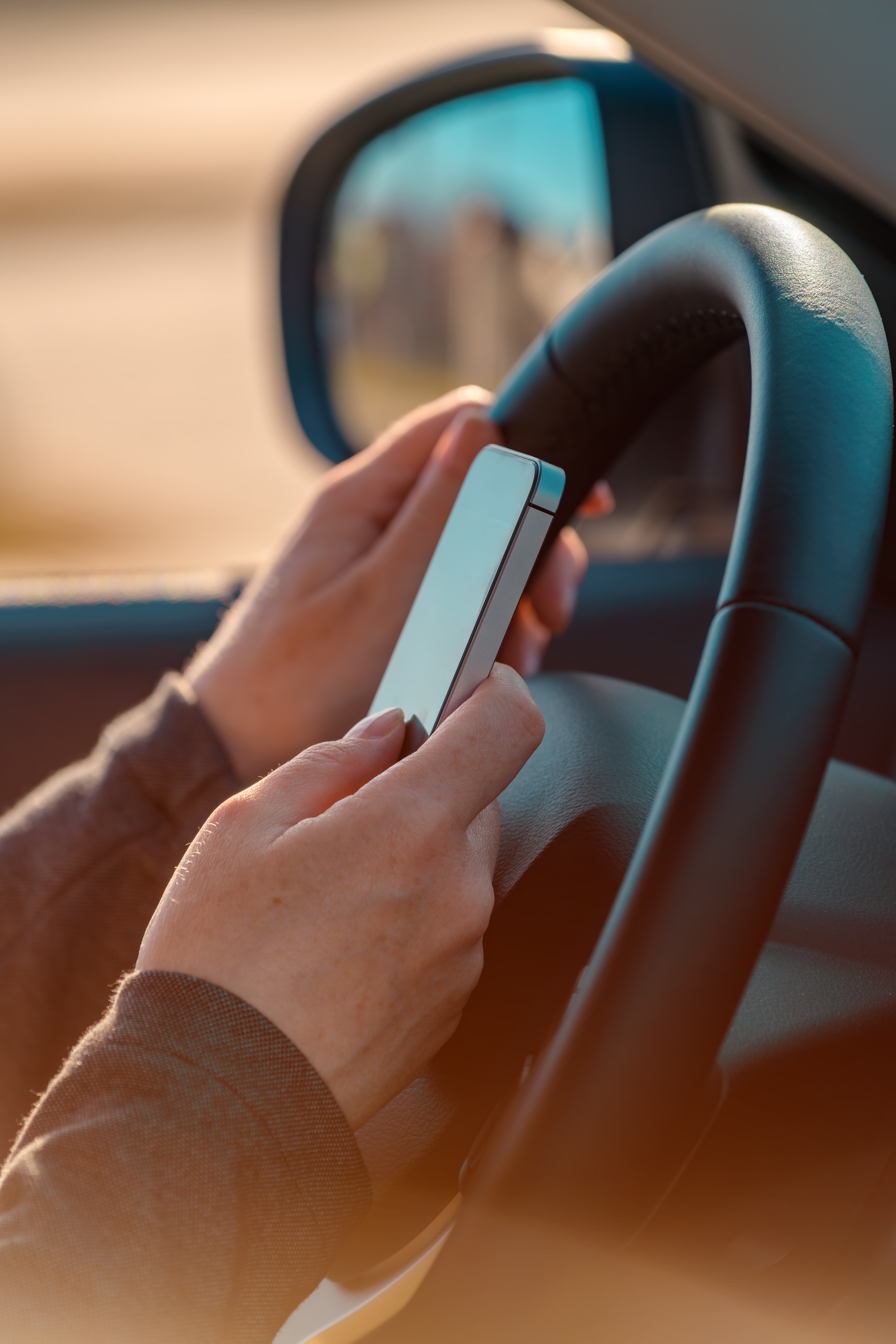
California Vehicle Code Section 23123 prohibits drivers from using a handheld cell phone while operating a vehicle. When a driver violates this law and causes an accident, California's negligence per se doctrine applies: the violation itself establishes negligence. You don't have to prove the driver was careless in general terms — the broken law does that work.
Texting, Scrolling, and App Use
Texting and driving is illegal under California law and among the most dangerous forms of distraction on the road. But the same legal exposure applies to a driver who was scrolling social media, adjusting a navigation app, or responding to a notification. The device activity is recoverable through carrier records and app logs — even if the driver deleted the messages.
Other Forms of Driver Inattention
Not every distracted driving crash involves a phone. Eating behind the wheel, adjusting in-car entertainment, reaching for something in the back seat, or rubbernecking at a prior accident are all recognized forms of inattention that can support an inattentive driver injury claim in California. Witness accounts, dashcam footage, and the physical evidence at the scene often tell this story clearly.
High-Distraction Corridors in San Diego
Certain stretches of San Diego road see disproportionate distracted driving crashes — the I-5 and SR-163 corridors, Mission Valley's surface streets, and downtown's dense intersection grid are among the most common locations we see in these cases. If your accident happened in one of these areas, traffic camera footage may already exist and needs to be preserved quickly.
How We Prove the Other Driver Was Distracted
The most common fear we hear from clients is that their case will come down to their word against the other driver's. In distracted driving cases, that is almost never true. The evidence trail is digital, and it is durable.
Here is how we build proof in a distracted driver lawsuit:
- Cell phone carrier subpoenas: Through the legal discovery process, we can compel the other driver's carrier to produce call logs, text timestamps, and data usage records from the time of the crash. Deleted texts do not erase the carrier's record of when they were sent.
- App activity and telematics data: Many modern vehicles record speed, braking, steering input, and driver behavior in the seconds before a collision. App logs can show whether a navigation app was being adjusted or a social media platform was open.
- Traffic and surveillance cameras: San Diego's major corridors and many commercial intersections have camera coverage. We move quickly to preserve this footage before it is overwritten.
- Witness statements: Bystanders, passengers, and other drivers often observe behavior that confirms what the data shows. We gather these accounts early, before memories fade.
- Physical evidence at the scene: Skid marks, point of impact, and vehicle damage patterns can contradict a driver's claim that they were paying full attention.
California's Negligence Per Se Rule and What It Means for Your Claim
If the driver who hit you was on a handheld device, California law gives your case a significant structural advantage. Under the negligence per se doctrine, a driver who violates a safety statute — like the state's cell phone law — is presumed to have acted negligently. You do not have to argue that the driver should have known better. The law already says so.
This matters because it shifts the burden in a meaningful way. Rather than building negligence from scratch, we start from a position of established liability and focus on documenting your injuries, your losses, and the full value of your claim. For victims who are worried their case isn't strong enough, this legal framework is often the clearest path forward.
What Your Distracted Driving Claim May Be Worth
No attorney can honestly quote a settlement number before reviewing your case. What we can tell you is what categories of loss California law allows you to recover — and that distracted driving cases often support claims for the full range.
Recoverable damages in a cell phone car accident or distracted driving crash typically include:
- Medical expenses, past and future
- Lost income and reduced earning capacity
- Pain and suffering
- Emotional distress
- Property damage
- In cases of egregious conduct, punitive damages may be available
The value of your claim depends on the severity of your injuries, the clarity of liability, the available insurance coverage, and how thoroughly your losses are documented. We work with medical providers and economic experts when the case warrants it — and because we limit our caseload, Brennan is personally involved in that analysis for every client.
Why Clients Choose Quigley for Distracted Driving Cases
Before founding this firm, Brennan Quigley spent years on the defense side, representing insurance companies in personal injury cases. He knows the internal logic insurers use to undervalue claims — and he knows what evidence changes that calculation. That background shapes how we build every case from the first consultation forward.
We are a seven-person firm by design. That means every client has direct access to Brennan, not a rotating cast of paralegals or junior associates. When you call, you reach the attorney handling your case. When your case goes to negotiation, the person across the table knows your file in full. For a distracted driving accident case where the details of how we prove liability matter enormously, that kind of attention is not a luxury — it is the difference between a claim that settles for what it is worth and one that doesn't.

Distracted Driving Accident FAQs
Can I sue a driver for texting and driving in California?
Yes. Texting while driving violates California Vehicle Code Section 23123, and that violation triggers the state's negligence per se doctrine — meaning the driver is presumed negligent by law. If you were injured as a result, you have a clear legal basis for a personal injury claim against that driver and, in most cases, their insurance carrier.Can you subpoena cell phone records after an accident?
Yes. Through the legal discovery process, we can compel a cell phone carrier to produce records showing call activity, text timestamps, and data usage at the time of the crash. These records are held by the carrier independently of what the driver does with their own device — deleting messages does not erase the carrier's logs.What if the other driver deleted their texts before I could prove anything?
Deleting texts from a personal device does not remove the record from the carrier's system. Carriers retain metadata — including when messages were sent and received — that is fully recoverable through a legal subpoena. In some cases, the deletion itself can be relevant to how the opposing party's conduct is characterized.What if the distracted driver denies being on their phone?
Denial is common. It is also rarely the end of the analysis. Cell phone records, vehicle telematics, traffic camera footage, and witness accounts can all establish what the driver was doing independently of what they say. In many cases, the physical evidence at the scene — the absence of braking, the point of impact — is inconsistent with a driver who was paying attention.Does distracted driving have to involve a phone to support a claim?
No. Any form of inattention that causes an accident can support a negligence claim in California. Eating while driving, adjusting a GPS device, reaching into the back seat, or being distracted by something outside the vehicle are all recognized forms of driver inattention. The legal standard is whether the driver failed to exercise reasonable care — and there are many ways to fail that standard beyond phone use.
Injured by a Distracted Driver in San Diego? Let's Talk.
You have a limited window to preserve the evidence that proves your case — phone records, camera footage, and telematics data do not stay available indefinitely. The sooner we get involved, the more complete the picture we can build. Call us at (619) 413-4405 or submit the contact form below for a free consultation. There is no fee unless we recover for you.